> For the complete documentation index, see [llms.txt](https://docs.cloudimage.io/llms.txt). Markdown versions of documentation pages are available by appending `.md` to page URLs; this page is available as [Markdown](https://docs.cloudimage.io/implementation/cms-plugins/shopify-tutorial/shopify-integration.md).
# Shopify integration
Shopify integration
Cloudimage will accelerate your Shopify shop by compressing images and delivering them over CDN.
## Step 1. Configure an origin HTTP-Storage in Cloudimage
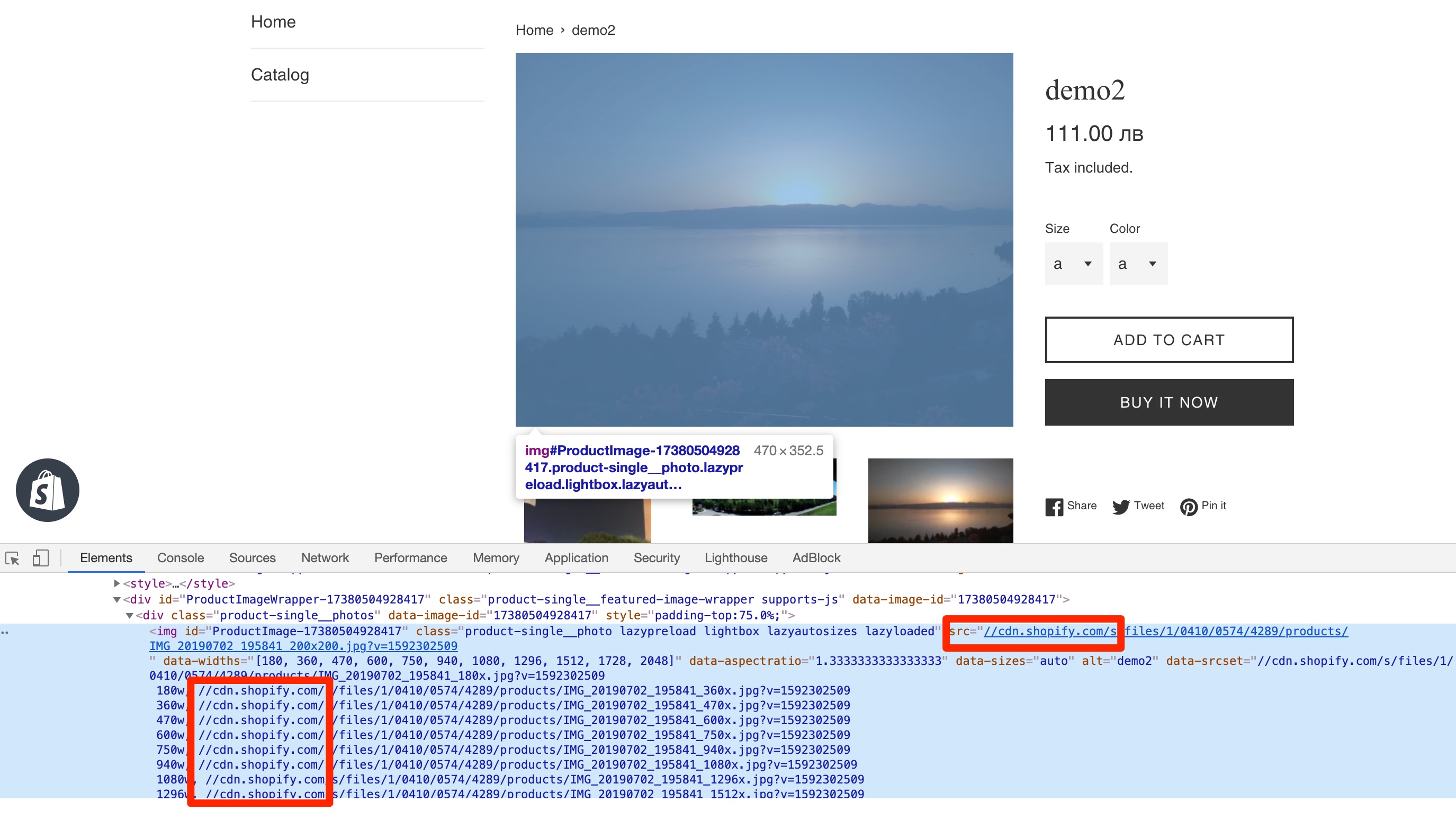
After finding out your Shopify URL as shown below (i.e. `https://cdn.shopify.com`, `https://cdn2.shopify.com` or `https://cdn.shopifycloud.com`), you can create a HTTP-Storage in Cloudimage.
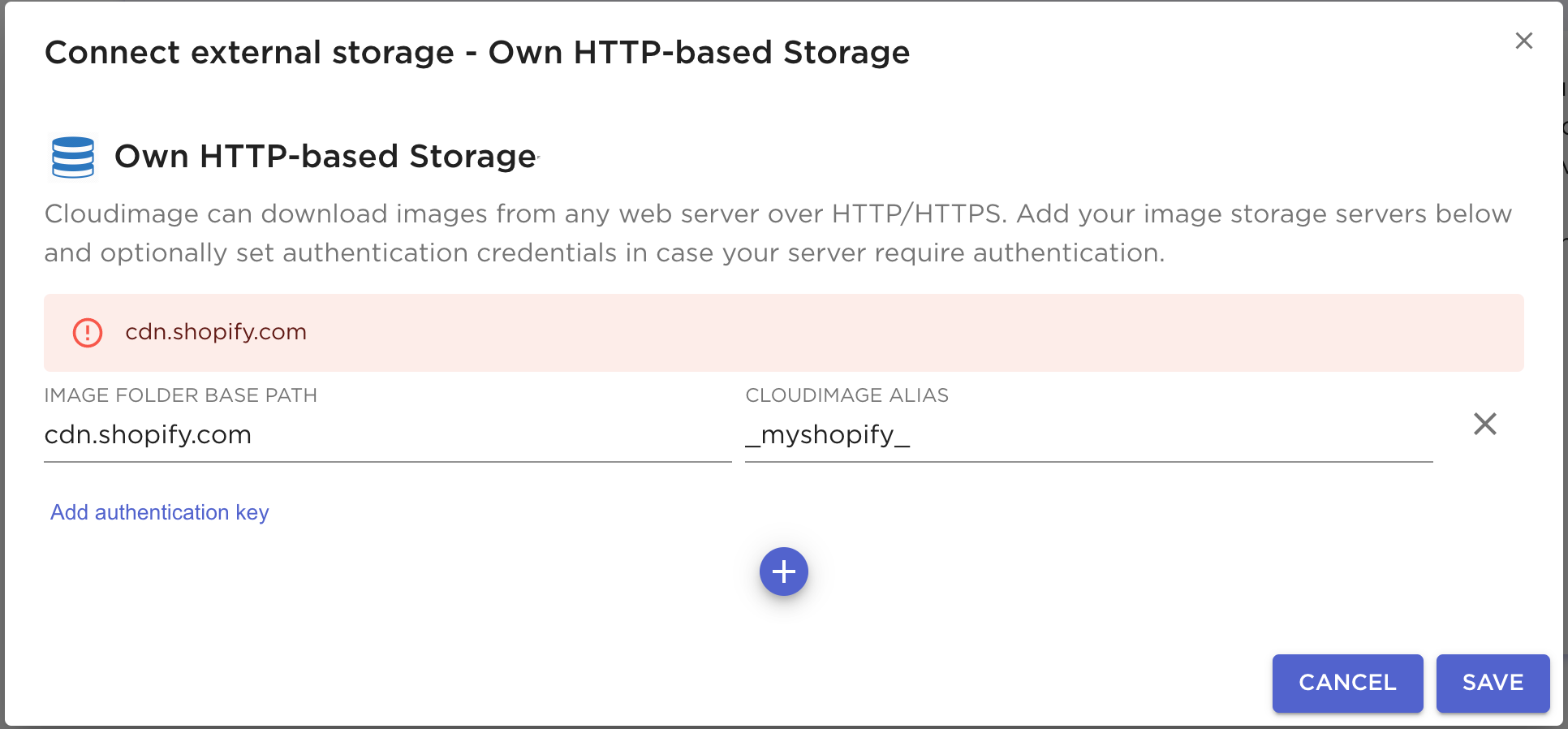
Create the Storage record in the Cloudimage admin as follows:
## Step 2. Verify alias
Adding an HTTP-based Storage will make you create a Cloudimage Alias. After saving the storage in Step 1 above, verify that images are delivered correctly over your Cloudimage URL with the Alias:
Origin image URL on Shopify:
Cloudimage URL with Alias:
`https://{token}.cloudimg.io/_myshopify_/shopifycloud/brochure/assets/home/hero-stock-small-72c1242fc5bbf6cfe135968110e9c52435af1e389c0fd4fe68208d21427e21e0.jpg`
Replace `{token}` with your Cloudimage token.
Unable to delivery images over your Cloudimage URL? Contact if you are not able to fetch the image as explained above. In such a situation, do not move to step 3 as this could break your website images.
## Step 3. Create settings\_schema.json
Proceed with making the changes in our Shopify settings and theme files to switch the image delivery to Cloudimage.
From your Shopify admin, click **Online Store > Themes**. Find the theme you want to edit, click the **Actions** button and then **Edit code**.
Under Config, click `settings_schema.json` and append the code below after the last section of this file:
```json
{
"name": "Cloudimage",
"settings": [
{
"type": "paragraph",
"content": "Check out Cloudimage's [Cloudimage and Shopify integration](https://docs.cloudimage.io/go/cloudimage-documentation-v7/en/dev-implementation/shopify-tutorial) to learn more about this."
},
{
"type": "checkbox",
"id": "enableCloudimage",
"label": "Enable Cloudimage"
},
{
"type": "text",
"id": "cloudImageToken",
"label": "Cloudimage Token",
"info": "The token of Cloudimage"
},
{
"type": "text",
"id": "cloudImageUrl",
"label": "Cloudimage url endpoint",
"info": "The url endpoint you set within Cloudimage. Example: //token.cloudimg.io/v7/_myshopify_"
},
{
"type": "text",
"id": "cloudimageShopifyCdnUrl",
"label": "Shopify CDN domain",
"default": "//cdn.shopify.com",
"info": "Do not change this unless you have a proxy in place. Not sure? Leave it as is."
}
]
}
```
## Step 4. Create cloudimage.liquid and cloudimage-video-tag.liquid file
Create new files `cloudimage.liquid` and `cloudimage-video-tag.liquid` under the **Snippets** directory. Copy the code below into that file, and save it:
* cloudimage.liquid
```php
{% capture CLOUDIMAGE %}
{% if settings.enableCloudimage%}
{% for i in (1..1) %}
{% unless src or settings.cloudImageUrl != blank %}
{{ src }}
{% break %}
{% endunless %}
{% assign cdnUrls = settings.cloudimageShopifyCdnUrl | split: ',' %}
{% if cdnUrls.size == 0 %}
{{ src }}
{% break %}
{% endif %}
{% assign cdnUrl = cdnUrls[0] %}
{% for temp in cdnUrls %}
{% if src contains temp %}
{% assign cdnUrl = temp %}
{% break %}
{% endif %}
{% endfor %}
{% assign cdnUrl = cdnUrl | strip %}
{% unless src contains cdnUrl %}
{{ src }}
{% break %}
{% endunless %}
{% assign cloudImageUrl = settings.cloudImageUrl | strip %}
{% assign tempCloudImageUrl = cloudImageUrl %}
{% assign lastChar = cloudImageUrl | slice:-1 %}
{% assign cloudImageUrlLength = cloudImageUrl | size %}
{% assign newCloudImageUrl = cloudImageUrlLength | minus:1 %}
{% if lastChar == "/" %}
{% assign tempCloudImageUrl = cloudImageUrl | slice:0,newCloudImageUrl %}
{% endif %}
{% assign newSrc = src | strip | replace:cdnUrl,tempCloudImageUrl %}
{{ newSrc | default:src }}
{% endfor %}
{% else %}
{{ src }}
{% endif %}
{% endcapture %}{{ CLOUDIMAGE | strip | replace:' ' | strip_newlines }}
```
* cloudimage-video-tag.liquid
```php
{% comment %}
Renders video tag
Accepts:
- image_size: {String} Size of media
- autoplay: {Boolean} Video autoplay
- loop: {String} Video loop
- controls: {Boolean} Video controls
- url: {String} Video url
- muted: {Boolean} Video muted
Usage:
{% render 'cloudimage-video-tag',
image_size: image_size,
autoplay: autoplay,
loop: loop,
controls: controls,
url: url,
muted: muted
%}
{% endcomment %}
{% if settings.enableCloudimage%}
{% for i in (1..1) %}
{% unless url or settings.cloudImageUrl != blank %}
{% assign newSrc = url %}
{% break %}
{% endunless %}
{% assign cdnUrls = settings.cloudimageShopifyCdnUrl | split: ',' %}
{% if cdnUrls.size == 0 %}
{% assign newSrc = url %}
{% break %}
{% endif %}
{% assign cdnUrl = cdnUrls[0] %}
{% for temp in cdnUrls %}
{% if url contains temp %}
{% assign cdnUrl = temp %}
{% break %}
{% endif %}
{% endfor %}
{% assign cdnUrl = cdnUrl | strip %}
{% unless url contains cdnUrl %}
{% assign newSrc = url %}
{% break %}
{% endunless %}
{% assign cloudImageUrl = settings.cloudImageUrl | strip %}
{% assign tempCloudImageUrl = cloudImageUrl %}
{% assign lastChar = cloudImageUrl | slice:-1 %}
{% assign cloudImageUrlLength = cloudImageUrl | size %}
{% assign newCloudImageUrl = cloudImageUrlLength | minus:1 %}
{% if lastChar == "/" %}
{% assign tempCloudImageUrl = cloudImageUrl | slice:0,newCloudImageUrl %}
{% endif %}
{% assign newSrc = url | strip | replace:cdnUrl,tempCloudImageUrl | append: '&func=proxy' %}
{% endfor %}
{% else %}
{% assign newSrc = url %}
{% endif %}
{%- if controls -%}
{% assign videoControls = 'controls="controls"' %}
{%- else -%}
{% assign videoControls = "" %}
{%- endif -%}
{%- if autoplay -%}
{% assign videoAutoplay = 'autoplay="autoplay"' %}
{%- else -%}
{% assign videoAutoplay = "" %}
{%- endif -%}
{%- if muted -%}
{% assign videoMuted = 'muted="muted"' %}
{%- else -%}
{% assign videoMuted = "" %}
{%- endif -%}
```
## Step 5. Enable Cloudimage
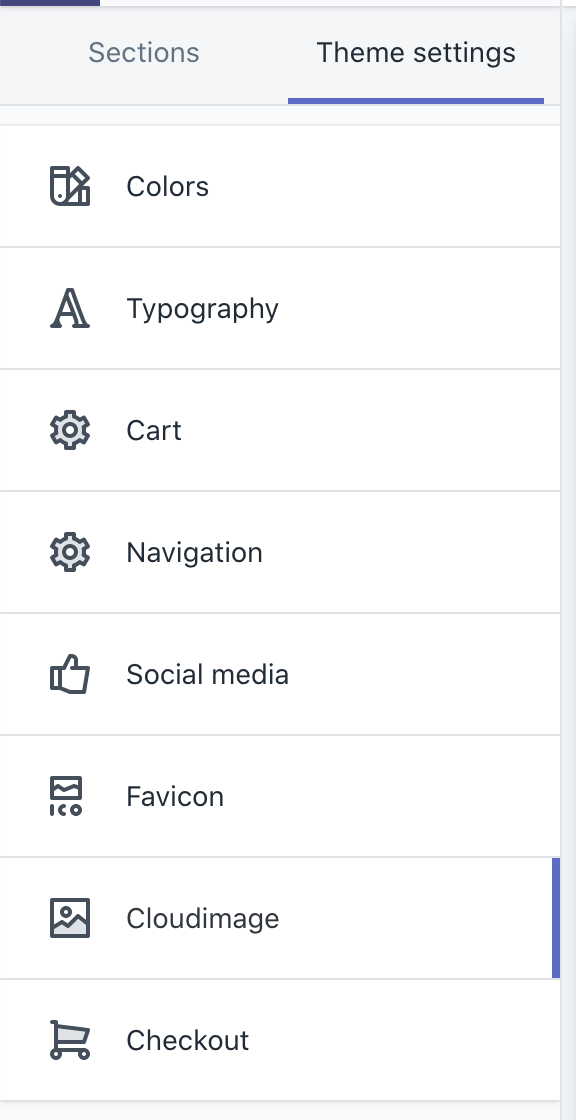
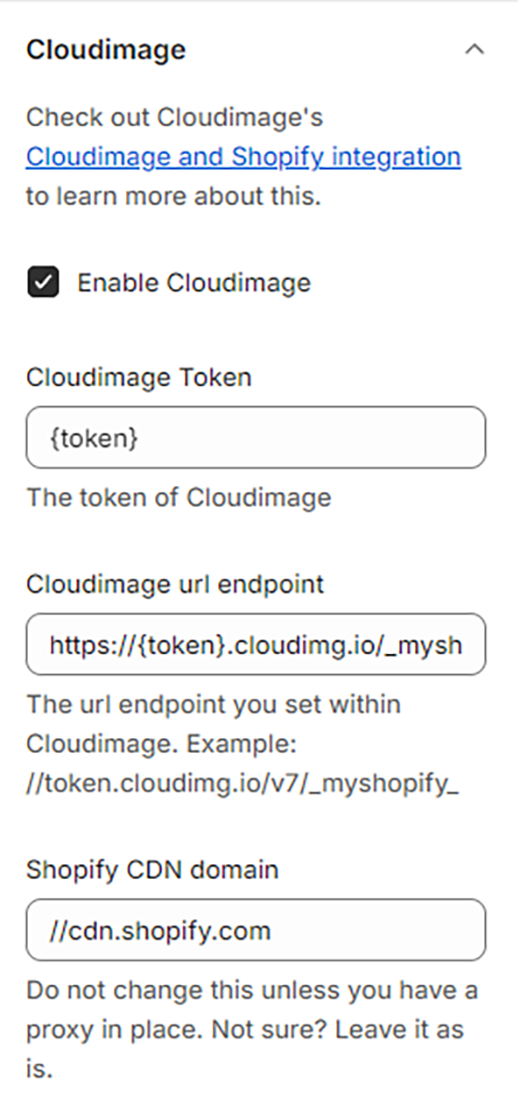
Navigate to **Online store > Themes > Customize theme**. In the sidebar, under **Theme Settings** open **Cloudimage** and enable it. Fill out the below two fields:
* **Cloudimage Token** - It should be your Cloudimage Token
* **Default URL endpoint** - It should be `//{token}.cloudimg.io/`*`myshopify`* (where `token` is your Cloudimage token)
* **Shopify CDN domain** - Its value should be `//cdn2.shopify.com`, `//cdn.shopify.com`
* Hit the "Save" button.
## Step 6. Edit your theme files
The final step of this tutorial is to adapt your theme files to start delivering your images over Cloudimage.
{% hint style="info" %}
**Backup your theme files.** Before making changes in these files, it is recommended that you download and save them securely to be able to restore them later in case of error.
{% endhint %}
For more information, please see the [Theme files](/implementation/cms-plugins/shopify-tutorial/theme-files.md) and [FAQ](/implementation/cms-plugins/shopify-tutorial/faq.md) sections.