> For the complete documentation index, see [llms.txt](https://docs.cloudimage.io/llms.txt). Markdown versions of documentation pages are available by appending `.md` to page URLs; this page is available as [Markdown](https://docs.cloudimage.io/setup/connecting-storage-bucket.md).
# Connecting storage bucket
Using third-party origin file storage
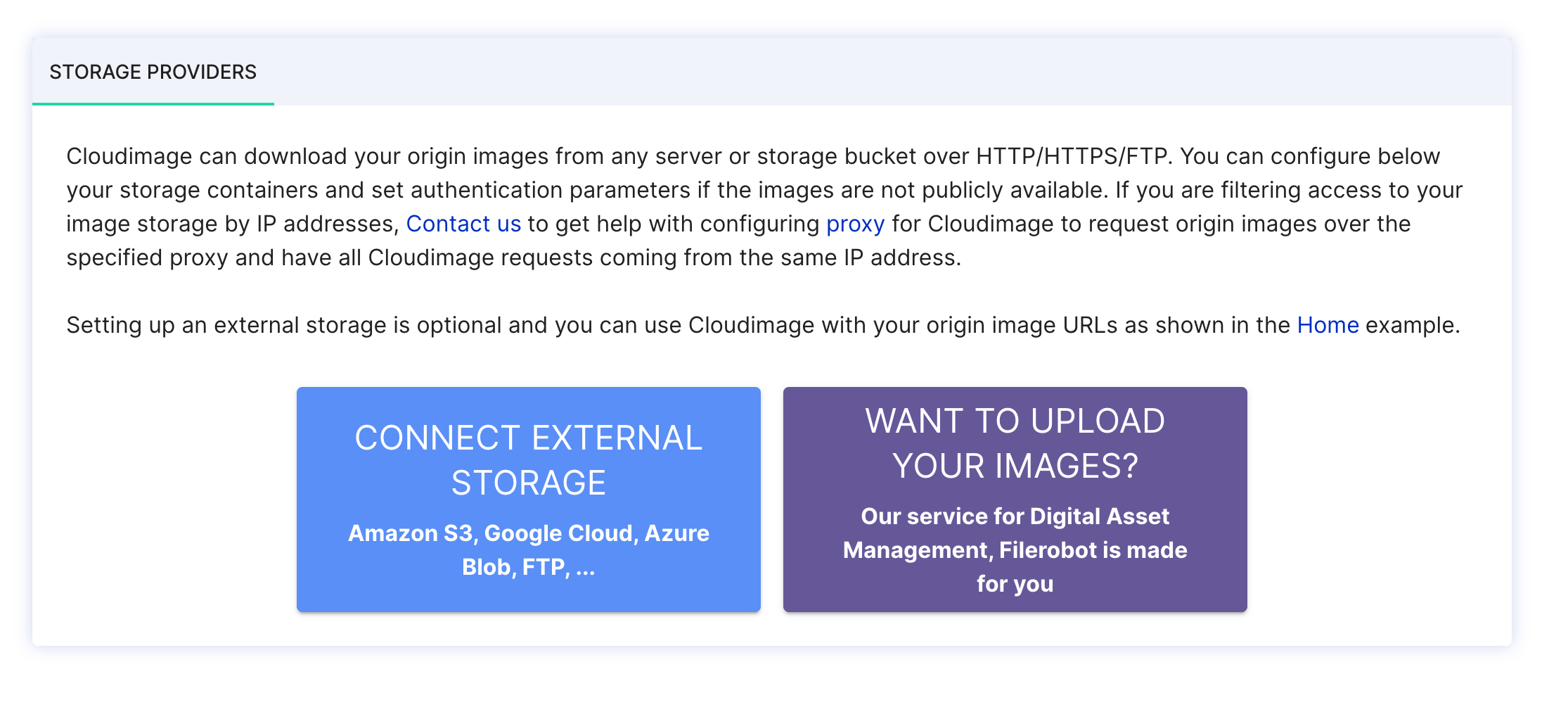
Cloudimage can download your origin images/files from any server or storage bucket over HTTP/HTTPS/FTP. Setting up an external storage is optional and you can use Cloudimage with your origin image URLs as shown in the introduction - [Welcome to Cloudimage](/readme.md).
If the images are not publicly available, you have to configure your storage containers and set authentication parameters. If you are filtering access to your image storage by IP addresses, [Contact us](https://admin.cloudimage.io/contact-us/) to get help with configuring [proxy](https://admin.cloudimage.io/project/settings/proxy) for Cloudimage to request origin images over the specified proxy and have all Cloudimage requests coming from the same IP address.
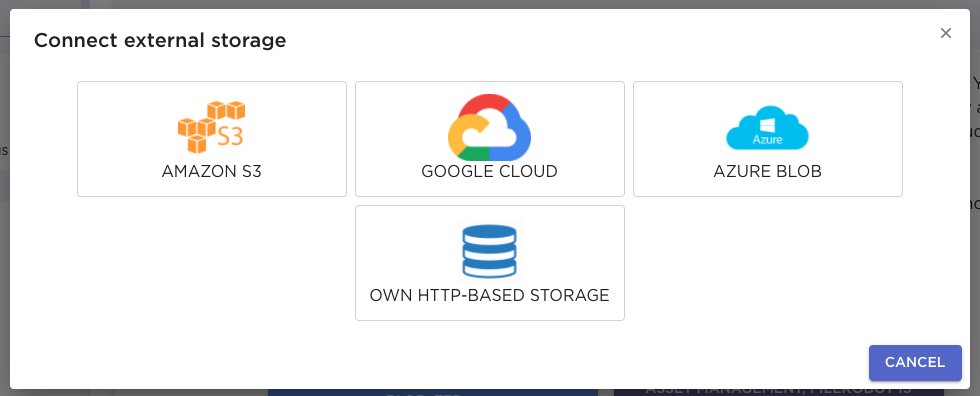
You can set up external storage in the *Storage* section in the admin panel by using the *Connect External Storage* button.
You can set up an [Amazon S3](/setup/connecting-storage-bucket/amazon-s3.md), [Google Cloud Storage](/setup/connecting-storage-bucket/google-cloud-storage.md), [Microsoft Azure Blob](/setup/connecting-storage-bucket/microsoft-azure-blob.md) or any generic HTTP-based storage (see [Basic authentication HTTP](/setup/connecting-storage-bucket/basic-authentication-http.md).